


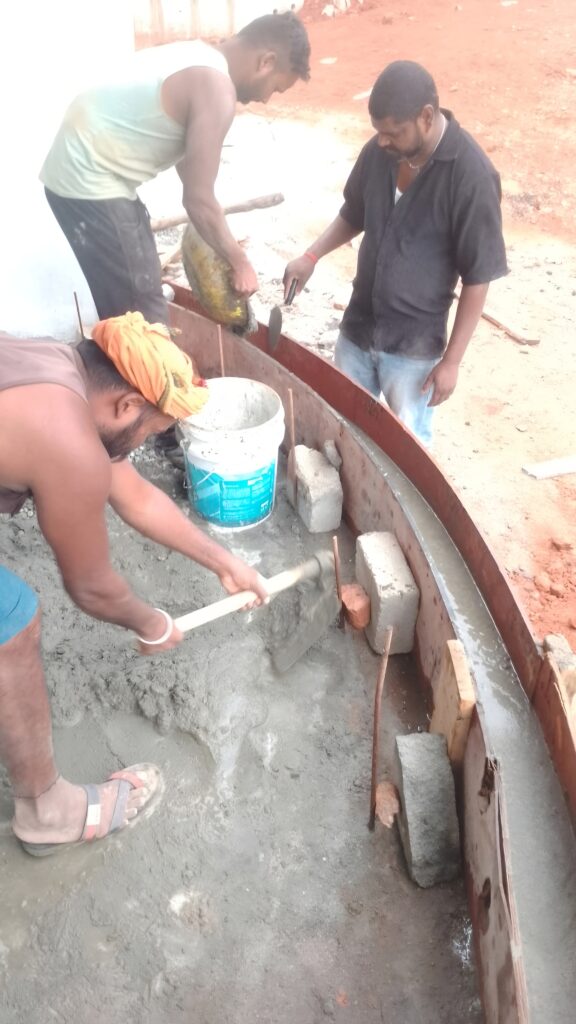
Modern construction projects often include curved structures to improve both appearance and functionality. Curved reinforced cement concrete (RCC) elements are commonly used in landscaping, retaining walls, decorative boundaries, swimming pools, water fountains, garden planters, amphitheaters, and commercial buildings. Unlike straight walls, curved concrete structures require accurate planning, skilled workmanship, and careful execution to achieve the desired shape and strength.
The construction of curved RCC formwork is more challenging because every stage—from setting out to curing—must be performed with precision. Even a small mistake during formwork installation or concrete placement can affect the final appearance and structural performance. Therefore, engineers and construction workers follow systematic procedures to ensure quality construction.
This guide explains the complete curved RCC formwork concreting process, including preparation, reinforcement, shuttering, concrete placement, finishing, curing, quality checks, and safety practices.
Understanding Curved RCC Formwork
Curved RCC formwork is a temporary structure that holds freshly placed concrete in the required curved shape until it gains sufficient strength. The formwork determines the final dimensions, alignment, and surface finish of the concrete.
Unlike straight formwork, curved formwork requires flexible materials or specially fabricated steel plates that can accurately follow the required radius. Strong support is necessary because fresh concrete produces significant lateral pressure.
Properly constructed formwork helps achieve:
- Smooth curved surfaces
- Accurate dimensions
- Structural stability
- Better appearance
- Reduced material wastage
Materials Required
Several construction materials are used during curved concreting work.
Cement
Ordinary Portland Cement (OPC) or Portland Pozzolana Cement (PPC) is generally used depending on project specifications.
Fine Aggregate
Clean river sand or manufactured sand provides workability and improves concrete finish.
Coarse Aggregate
Well-graded crushed stone with appropriate size ensures strength and durability.
Water
Only clean water free from harmful chemicals should be used for mixing and curing.
Reinforcement Steel
High-yield strength deformed bars (HYSD) provide tensile strength and improve structural performance.
Steel Formwork
Steel plates are commonly used because they can maintain curved shapes accurately while resisting concrete pressure.
Site Preparation
Construction begins with proper site preparation. The working area should be cleaned thoroughly before marking the layout.
Engineers establish reference points using surveying instruments. The curve radius is measured carefully because accurate layout ensures correct positioning of the formwork.
Loose soil, debris, and unwanted materials are removed from the construction area. A stable base prevents movement during concreting.
Reinforcement Placement
Reinforcement plays an essential role in curved concrete structures.
Steel bars are bent according to approved drawings. Skilled bar benders prepare the required radius without damaging the steel.
The reinforcement cage is tied securely using binding wire. Concrete cover blocks maintain the specified distance between reinforcement and formwork.
Before concreting begins, engineers inspect:
- Bar diameter
- Spacing
- Lap lengths
- Anchorage
- Cover thickness
- Structural alignment
Only after approval can concrete work proceed.
Installation of Curved Formwork
Formwork installation is one of the most important stages.
Steel sheets or specially fabricated curved plates are positioned according to the design radius.
Supports and braces are installed to prevent movement during concrete pouring.
Construction workers continuously verify:
- Vertical alignment
- Curve accuracy
- Joint tightness
- Level differences
All gaps are sealed properly to prevent cement slurry leakage.
Concrete Mixing
Concrete quality depends greatly on proper mixing.
Materials should be measured according to the approved mix design.
Mechanical mixers ensure uniform mixing and consistent quality.
Depending on project requirements, admixtures may be added to improve:
- Workability
- Setting time
- Durability
- Strength
Concrete should never contain excessive water because it reduces strength and increases shrinkage.
Concrete Pouring
Concrete placement begins only after final inspection.
Workers pour concrete gradually rather than placing large quantities in one location.
Uniform placement reduces segregation and ensures better compaction.
During pouring:
- Concrete should remain workable.
- Reinforcement should not shift.
- Formwork should remain stable.
- Workers should avoid dropping concrete from excessive heights.
Careful placement helps maintain the required curved profile.
Concrete Compaction
Proper compaction removes trapped air.
Needle vibrators are commonly used for RCC work.
Effective vibration provides several advantages:
- Higher density
- Increased strength
- Better bond with reinforcement
- Reduced honeycombing
- Improved durability
However, excessive vibration should be avoided because it may cause segregation.
Surface Finishing
After compaction, workers finish the exposed concrete surface.
Trowels and floats create a smooth finish while maintaining the designed curve.
Any excess concrete is removed immediately.
Proper finishing improves appearance and reduces future repair work.
Curing Process
Curing is essential for achieving design strength.
Fresh concrete must remain moist for the recommended curing period.
Water curing helps:
- Prevent shrinkage cracks
- Increase compressive strength
- Improve durability
- Reduce permeability
- Enhance long-term performance
For most structures, curing continues for at least seven days, while longer curing provides better results.
Quality Control
Quality control begins before construction and continues until completion.
Engineers inspect:
- Concrete consistency
- Formwork alignment
- Reinforcement placement
- Cover thickness
- Concrete finish
- Curing methods
Cube tests may be conducted to verify compressive strength according to project specifications.
Common Construction Challenges
Curved concreting requires careful supervision because several problems may occur.
Formwork Movement
Weak supports can shift during concreting, causing dimensional errors.
Honeycombing
Poor vibration leaves voids within the concrete.
Surface Cracks
Improper curing often causes early-age cracking.
Segregation
Excessive water or improper pouring separates aggregates from cement paste.
Leakage
Poorly sealed formwork joints allow cement slurry to escape.
Proper planning minimizes these issues.
Safety Measures
Construction safety is always a priority.
Workers should wear:
- Safety helmets
- Gloves
- Safety shoes
- Reflective jackets
- Eye protection
Work areas should remain clean to reduce slipping hazards.
Only trained personnel should operate vibrators and other construction equipment.
Advantages of Curved RCC Construction
Curved concrete structures offer several benefits.
Attractive Appearance
Curved designs improve the architectural beauty of buildings and landscapes.
Better Load Distribution
Smooth curves distribute stresses more efficiently in certain applications.
High Durability
Properly constructed RCC structures perform well under various environmental conditions.
Low Maintenance
Quality construction reduces repair costs throughout the structure’s service life.
Design Flexibility
Curved RCC allows architects to create unique and attractive layouts.
Applications
Curved RCC formwork is widely used in:
- Landscape retaining walls
- Water fountains
- Swimming pools
- Circular buildings
- Amphitheaters
- Garden planters
- Curved compound walls
- Public parks
- Commercial buildings
- Decorative architectural features
Best Practices
Successful curved concreting depends on following established construction practices.
Always verify dimensions before installing formwork.
Use high-quality materials.
Maintain proper reinforcement cover.
Ensure complete compaction.
Prevent formwork movement.
Follow recommended curing procedures.
Inspect every construction stage before moving to the next activity.
Conclusion
Curved RCC formwork concreting combines engineering accuracy with skilled craftsmanship. Every stage—from layout preparation and reinforcement installation to formwork fixing, concrete placement, vibration, finishing, and curing—contributes to the overall quality of the structure. Proper supervision, quality materials, and adherence to construction standards ensure a durable, attractive, and long-lasting curved concrete element.
Whether used for decorative landscaping, retaining walls, architectural features, or infrastructure projects, curved RCC construction provides excellent strength, durability, and visual appeal. By following best construction practices and maintaining strict quality control, engineers can deliver structures that perform reliably for decades while enhancing the aesthetics of modern development.
Tags
Curved RCC Formwork, RCC Construction, Curved Concrete Wall, Steel Shuttering, Concrete Pouring, Civil Engineering, Reinforcement Work, Construction Site, Formwork Installation, Concrete Curing, RCC Wall Construction, Site Engineering, Structural Concrete, Building Construction, Construction Technology
click here
Share this content: