

Sewage and drainage systems are an important part of every residential, commercial, industrial and infrastructure project. A properly designed underground drainage network helps carry wastewater, rainwater and other unwanted water away from buildings and populated areas. For this purpose, different types of pipes are used depending on the soil condition, depth of installation, traffic load, discharge requirements and project specifications.
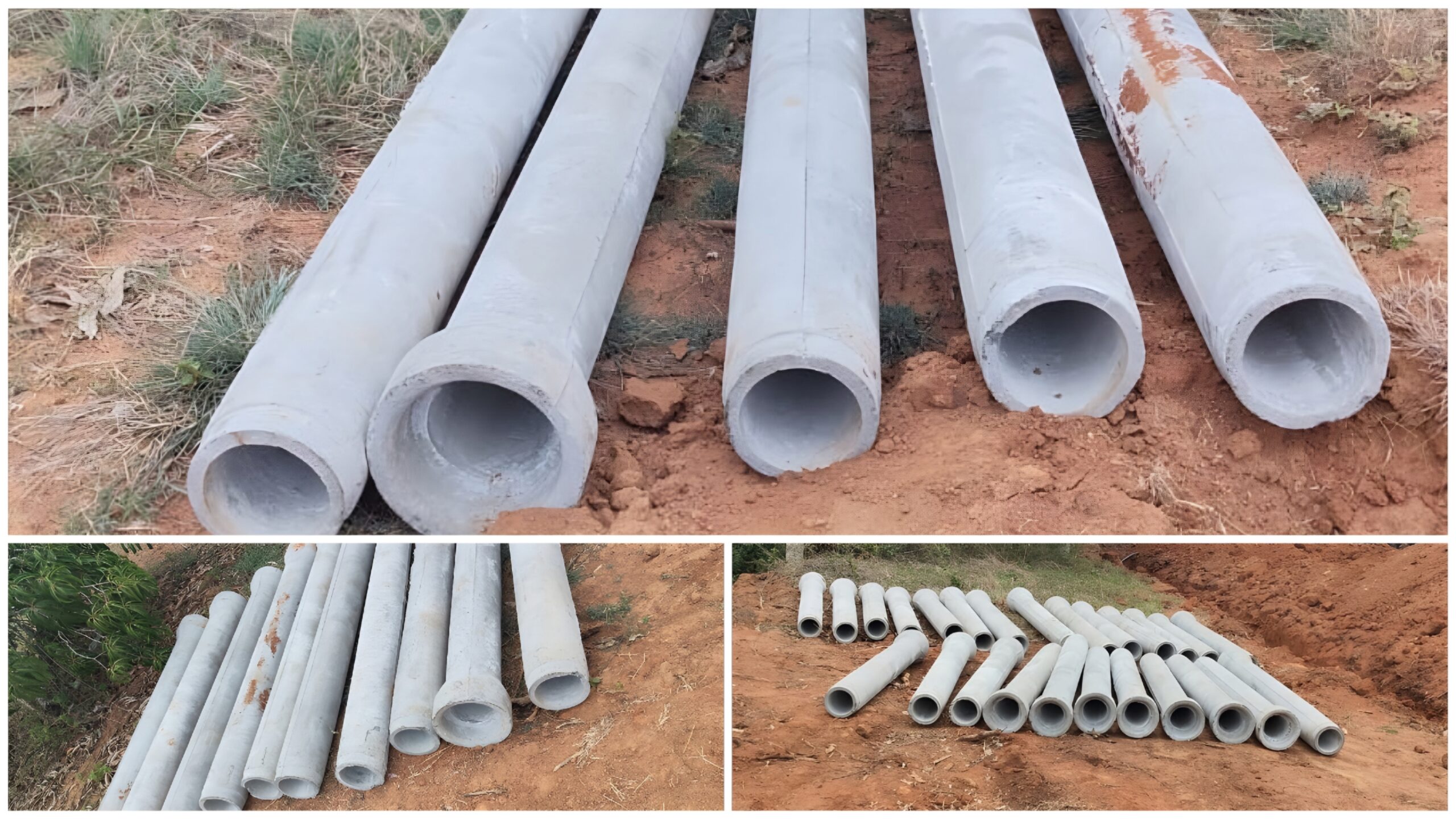
The image shown above represents RCC sewage and drainage pipes, commonly known as concrete pipes. Among the different classifications used for RCC pipes, NP2 and NP3 pipes are widely used in drainage, sewerage and culvert-related works. These pipes are manufactured from cement concrete and reinforcement steel, which gives them good strength and durability for underground applications.
Although NP2 and NP3 pipes may look similar from the outside, they are not exactly the same. Their structural capacity, reinforcement arrangement and suitability for different loading conditions can vary. Therefore, selecting the correct pipe class is important for achieving a safe and long-lasting drainage system.

What Are RCC Sewage Pipes?
RCC stands for Reinforced Cement Concrete. RCC pipes are manufactured using cement, fine aggregate, coarse aggregate, water and steel reinforcement. The concrete provides compressive strength, while the reinforcement helps the pipe resist tensile stresses and external loading.
These pipes are generally manufactured in cylindrical shapes with a hollow internal section. The hollow portion provides a passage for wastewater, stormwater or other fluids. Depending on the project, pipes can be manufactured in different internal diameters, lengths and strength classes.
RCC pipes are commonly used below roads, residential layouts, agricultural areas, commercial developments and other locations where underground drainage is required.
One of the major benefits of RCC pipes is their ability to withstand substantial external loads when they are correctly designed, manufactured and installed.
What Does NP Mean in RCC Pipes?
The term NP is used in the classification of certain RCC pipes manufactured for non-pressure applications. In simple terms, these pipes are generally intended for systems where water flows through the pipe mainly because of gravity rather than being pumped under high internal pressure.
NP pipes are commonly encountered in sewerage, drainage and stormwater applications.
The classification includes different grades, and the required grade depends on the structural and service conditions of the project.
Two commonly encountered classes are:
- NP2 RCC pipes
- NP3 RCC pipes
The exact pipe selection should always follow the approved project drawings, design calculations and applicable specifications.
What Is an NP2 Pipe?
An NP2 pipe is an RCC pipe manufactured for non-pressure drainage and sewerage applications. It is commonly selected for underground drainage works where the external loading conditions are within the capacity of the pipe.
NP2 pipes can be used for wastewater drainage, stormwater drainage and similar gravity-flow systems.
They are particularly useful where the pipe is installed at a suitable depth and is not exposed to unusually high external loads.
For example, NP2 pipes may be considered in certain residential drainage networks, open areas, smaller drainage systems and locations where heavy traffic loading is not expected directly above the pipe.
However, the suitability of NP2 should not be decided only by looking at the pipe diameter. Soil condition, trench depth, bedding, backfilling quality and surface loading also have a major effect on pipe performance.
What Is an NP3 Pipe?
An NP3 pipe is another class of RCC pipe used for non-pressure drainage and sewerage applications. Compared with lower-strength classifications, NP3 is generally selected where greater structural performance is required.
These pipes are useful in locations where the pipe may experience higher external loads or more demanding installation conditions.
For example, an NP3 pipe may be considered for drainage lines installed beneath roads or areas subjected to greater loading, depending on the design requirements.
The additional structural capacity does not mean that an NP3 pipe can simply be installed without proper bedding and backfilling. Even a stronger pipe can be damaged if the trench is poorly prepared or if construction equipment applies excessive load during installation.
Difference Between NP2 and NP3 Pipes
NP2 and NP3 pipes are both used for gravity drainage and sewerage systems, but their structural characteristics are different.
| Feature | NP2 Pipe | NP3 Pipe |
|---|---|---|
| Basic material | RCC | RCC |
| Application | Non-pressure drainage | Non-pressure drainage |
| Typical use | Less demanding loading conditions | More demanding loading conditions |
| Structural requirement | Lower than NP3 | Higher than NP2 |
| Suitable locations | Residential and general drainage works depending on design | Road crossings and higher-load locations depending on design |
| Installation | Requires proper bedding and backfilling | Requires proper bedding and backfilling |
| Internal flow | Gravity flow | Gravity flow |
| Selection | Based on project conditions | Based on project conditions |
The table gives a general understanding. The actual pipe class should always be selected according to the engineering design and applicable standards rather than using a fixed rule for every project.
Where Are NP2 Pipes Used?
NP2 pipes can be used in several drainage applications when the expected loading and installation conditions are suitable.
Some common applications include:
1. Residential Drainage
Housing layouts require underground drainage systems to transport wastewater and rainwater. RCC pipes can be used for these networks where their size and strength are suitable.
2. Stormwater Drainage
During heavy rainfall, stormwater must be collected and discharged safely. RCC pipes can be used as underground stormwater conduits.
3. Agricultural Drainage
In some agricultural and land-development projects, concrete pipes can be used to carry excess water away from cultivated or developed areas.
4. Small Drainage Networks
NP2 pipes can also be considered for smaller gravity drainage systems where the structural requirements are within the pipe’s designed capacity.
Where Are NP3 Pipes Used?
NP3 pipes are useful where the drainage line needs greater structural resistance.
Typical applications can include:
Road Drainage
Drainage pipes installed beneath roads can experience significant external loading from vehicles and pavement layers. Therefore, an appropriately designed higher-strength pipe may be required.
Stormwater Crossings
Where stormwater needs to pass beneath roads, pathways or developed areas, RCC pipes can provide a strong underground passage.
Sewerage Networks
NP3 pipes can be used in gravity sewer networks where the expected structural loading requires this class.
Culvert-Type Applications
Concrete pipes are also used in certain small cross-drainage and culvert applications, subject to hydraulic and structural design.
Importance of Pipe Diameter
The diameter of an RCC sewage pipe is an important factor in drainage design. A larger diameter allows a greater quantity of water to pass through the pipe, but simply selecting the largest available pipe is not an efficient engineering solution.
The required diameter depends on factors such as:
- Expected wastewater discharge
- Stormwater runoff
- Catchment area
- Pipe slope
- Flow velocity
- Hydraulic calculations
- Future expansion
- Ground conditions
For a sewerage network, engineers normally determine the expected flow and then select an appropriate pipe diameter and gradient.
Importance of Pipe Slope
RCC sewage pipes generally operate using gravity flow. Therefore, maintaining the correct slope is extremely important.
If the slope is too low, water may flow slowly and solids can settle inside the pipe. Over time, this may contribute to blockage and maintenance problems.
On the other hand, an excessively steep slope can produce high flow velocities and may not always be suitable for the intended system.
Therefore, the pipe gradient should be established according to the project design.
During construction, survey instruments or appropriate leveling equipment should be used to maintain the required invert level.
RCC Pipe Bedding
Pipe bedding is one of the most important parts of underground pipe installation.
Before laying an RCC pipe, the trench bottom should be prepared properly. Loose soil, organic material, debris and unsuitable material should be removed.
Depending on the design, a suitable bedding layer may be provided below the pipe. The purpose of bedding is to provide uniform support along the pipe and prevent concentrated loads.
A pipe should not be supported only at a few points because this can create stress concentrations.
Proper bedding distributes the load and helps improve the long-term performance of the drainage line.
Installation Process of NP2 and NP3 Pipes
The installation process should be carried out carefully because pipe performance depends not only on manufacturing quality but also on site workmanship.
Step 1: Setting Out
First, the drainage alignment is marked according to the approved drawing. The location, pipe centerline and required levels are checked before excavation begins.
Step 2: Excavation
The trench is excavated to the required width and depth. Excavation should be carried out carefully to avoid unnecessary disturbance to the surrounding soil.
If the trench is deep, suitable safety measures should be provided according to site conditions.
Step 3: Preparing the Trench Bottom
The trench bottom is cleaned and brought to the required level. Any soft or unsuitable soil should be treated according to the engineering requirements.
Step 4: Providing Bedding
A suitable bedding material is placed and leveled. The bedding should provide continuous and uniform support to the pipe.
Step 5: Lowering the Pipes
RCC pipes are heavy, so proper lifting equipment should be used where required. Workers should avoid dropping or dragging pipes because this can damage the pipe ends.
Step 6: Aligning the Pipes
The pipes are placed along the designed centerline and gradient. The joint area should be properly aligned before the next pipe is installed.
Step 7: Jointing
Pipe joints are completed according to the specified jointing method and project requirements. The objective is to obtain a properly connected drainage line and reduce the possibility of leakage or soil entering the pipe.
Step 8: Checking Levels
After laying the pipes, the invert levels and alignment should be checked. This is particularly important for gravity sewer systems.
Step 9: Side Filling
Suitable material is placed carefully around the sides of the pipe. Proper compaction around the pipe helps provide lateral support.
Step 10: Backfilling
The trench is then backfilled in suitable layers. Each layer should be compacted according to the project specification.
Poor backfilling is one of the common reasons for settlement above underground drainage lines.
Advantages of RCC NP2 and NP3 Pipes
RCC pipes have several advantages that make them suitable for underground drainage construction.
High Compressive Strength
Concrete has good compressive strength and can withstand significant loads when the pipe is properly designed and supported.
Long Service Life
When correctly manufactured and installed, RCC pipes can provide a long service life in underground applications.
Suitable for Underground Drainage
The strong cylindrical structure makes RCC pipes useful for sewerage and stormwater networks.
Good Resistance to External Loads
Appropriately designed RCC pipes can withstand external soil and surface loads.
Large Diameter Availability
RCC pipes are available in different diameters, making them suitable for various drainage requirements.
Economical for Large Projects
For many infrastructure and drainage projects, RCC pipes can be a practical option, particularly where large quantities are required.
Limitations of RCC Pipes
Although RCC pipes have many advantages, they also have certain limitations.
First, they are significantly heavier than many plastic pipe alternatives. Therefore, transportation, unloading and installation may require machinery.
Second, improper handling can damage the pipe ends or body.
Third, RCC pipes require careful jointing and proper bedding.
Another important consideration is chemical exposure. Certain wastewater environments may be aggressive to concrete. Therefore, the nature of the wastewater should be considered during design.
NP2 or NP3: Which Pipe Is Better?
There is no universal answer that NP3 is always better than NP2.
The correct pipe depends on the conditions of the project.
If the expected loading and installation conditions are suitable for NP2, selecting a higher class may unnecessarily increase project cost.
However, if the pipe is subjected to greater external loading, an appropriately higher-strength classification may be required.
For this reason, pipe selection should consider:
- Depth of burial
- Soil type
- Groundwater conditions
- Road traffic
- Surface loading
- Trench width
- Bedding condition
- Backfill material
- Pipe diameter
- Drainage flow
- Project specifications
An engineer should evaluate these conditions before finalizing the pipe class.
Quality Checks Before Installation
Before RCC pipes are installed, the pipes should be inspected at the construction site.
The following points should be checked:
- Pipe diameter should match the approved requirement.
- Pipes should not have major cracks.
- Pipe ends should be in acceptable condition.
- The concrete surface should be properly formed.
- Reinforcement should comply with the specified manufacturing requirements.
- Pipes should be handled without unnecessary impact.
- Damaged pipes should be separated and evaluated before use.
Quality control at this stage can prevent problems after the drainage line has been covered.
Common Mistakes During RCC Pipe Installation
Several construction mistakes can reduce the service life of a drainage pipeline.
One common mistake is laying pipes directly on uneven soil without proper bedding.
Another problem is failing to maintain the required slope. Even a high-quality pipe can perform poorly if the drainage gradient is incorrect.
Improper jointing can also cause leakage and allow surrounding soil to enter the pipeline.
Similarly, careless backfilling can create voids around the pipe. Later, these voids may result in settlement of the ground surface.
Heavy construction equipment should also not be operated directly over a newly installed pipe until adequate cover and compaction have been achieved.
Maintenance of RCC Sewerage Pipes
RCC sewerage systems generally require less frequent maintenance when they are correctly designed and installed. However, inspection is still important.
Drainage lines should be checked periodically for blockages, sediment accumulation, joint problems and structural damage.
Manholes and inspection chambers provide access for cleaning and inspection.
If a blockage occurs, suitable cleaning equipment can be used to restore the flow. Regular maintenance is particularly important in stormwater systems because leaves, soil, plastic waste and other materials can enter the network.
NP2 and NP3 Pipes in Building Construction
For building projects, underground drainage is normally planned before finishing the external works. The sewer pipes connect toilets, bathrooms, kitchens and other wastewater sources to the main drainage network.
The pipe size, slope and class should be determined according to the building design.
RCC pipes are generally more common for larger external drainage networks than for small internal plumbing lines. Smaller internal plumbing systems may use other pipe materials depending on the project.
Therefore, NP2 and NP3 RCC pipes should be viewed mainly as part of the external underground drainage and sewerage infrastructure.
Why Proper Backfilling Matters
Many people focus on the pipe itself and ignore the soil surrounding it. However, underground pipe performance depends greatly on the interaction between the pipe and the surrounding soil.
Properly compacted side filling provides support to the pipe. It also reduces the possibility of ground settlement.
Backfill should be placed carefully and compacted in layers rather than dumping a large quantity of soil over the pipe at once.
This is particularly important below roads and other areas carrying heavy loads.
Conclusion
NP2 and NP3 RCC pipes are important components of underground sewerage, drainage and stormwater systems. The pipes shown in the figure are examples of the type of concrete pipes commonly used for these applications.
NP2 and NP3 belong to the non-pressure pipe category and are primarily intended for gravity-flow drainage systems. Although both types serve similar purposes, their structural requirements and suitability for different loading conditions are not identical.
NP2 can be suitable for applications where the expected external loads are within its designed capacity. NP3 can be considered when greater structural performance is required. However, pipe selection should never be based only on the name of the pipe class. Soil condition, burial depth, traffic load, bedding, backfilling, pipe diameter and hydraulic requirements should all be considered.
Most importantly, even a high-quality RCC pipe can fail if installation is carried out poorly. Proper setting out, excavation, bedding, alignment, jointing, level checking and backfilling are essential for obtaining a reliable drainage system.
For construction professionals, understanding the difference between NP2 and NP3 pipes helps in making better decisions during sewerage and drainage works. A correctly selected and properly installed RCC pipe network can provide dependable drainage performance for many years.
The pipes shown in the figure therefore represent more than simple concrete cylinders. They are structural components of an underground drainage system, and their performance depends on both pipe quality and construction quality. By selecting the appropriate pipe class and following proper installation practices, engineers and contractors can build drainage networks that are strong, functional and durable.
also check here
Share this content: