Retaining Wall Side Drain: Construction, Purpose, Types, Advantages and Important Details

Drainage is one of the most important parts of road, building and infrastructure construction. Whenever a retaining wall is constructed to hold back soil, proper water management becomes essential. Water should not be allowed to accumulate beside the wall because continuous exposure to water can affect the surrounding soil, increase pressure and create maintenance problems.
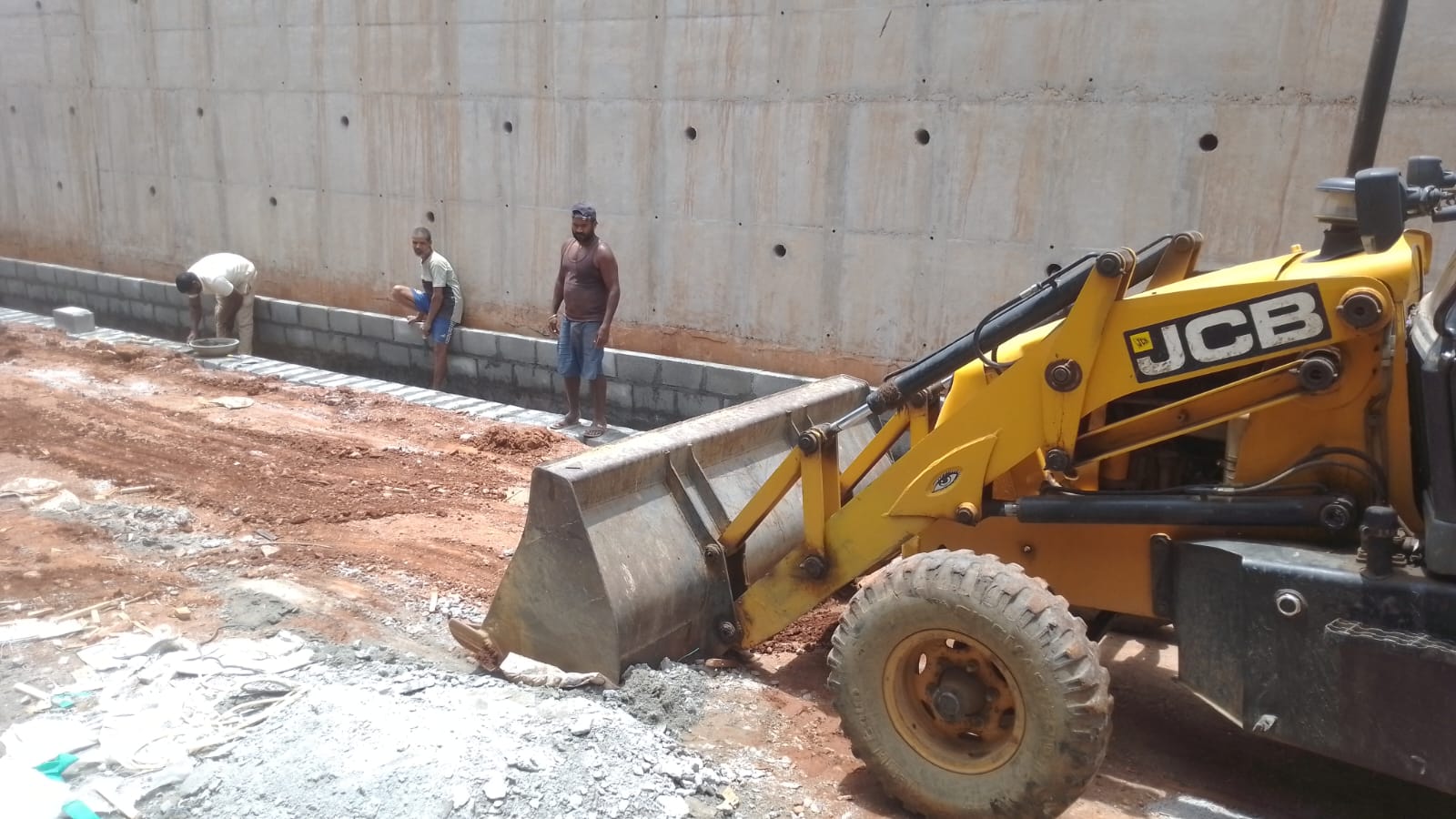
The image shown above represents a side drain constructed along a retaining wall. The drain is formed beside the retaining structure and is intended to collect and guide surface water away from the area. Masonry work is visible along the drain, while construction equipment is being used for excavation and site preparation.
A retaining wall provides support to soil, but the drainage arrangement around the wall is equally important. A properly constructed side drain can collect rainwater and other surface runoff and safely direct it toward a suitable discharge point.
However, it is important to understand that a side drain alone does not replace the drainage system provided behind a retaining wall. Both systems can have different functions and should be planned according to the site conditions.
What Is a Retaining Wall Side Drain?
A retaining wall side drain is a drainage channel constructed alongside or near a retaining wall to collect and carry surface water.
During rainfall, water flows over the surrounding ground and may move toward the retaining wall. If there is no proper drainage path, water can accumulate near the wall. A side drain provides a controlled route for this water to travel toward an outlet.
Depending on the project, the side drain may be constructed using:
- Brick masonry
- Concrete blocks
- Stone masonry
- Plain cement concrete
- Reinforced concrete
- Precast drainage sections
- Other approved drainage materials
The exact construction method depends on the project drawings, hydraulic requirements, site conditions and specifications.
In the photograph, masonry/blockwork is being constructed to form the sides of the drainage channel. The channel can then be finished with the required base, slope and outlet arrangement.
Why Is Drainage Important Near a Retaining Wall?
A retaining wall is designed to resist lateral pressure from the soil behind it. However, when water enters the soil and cannot drain away properly, the condition becomes more complicated.
Water can increase the pressure acting against the wall. In addition, saturated soil can behave differently from relatively dry soil.
Therefore, drainage is an important part of retaining-wall construction.
A good drainage arrangement helps:
- Collect surface runoff
- Prevent water accumulation
- Reduce erosion
- Direct rainwater toward an outlet
- Protect nearby pavement and soil
- Reduce maintenance problems
- Improve the overall performance of the site drainage system
For this reason, drainage should be considered during the initial planning stage rather than being treated as an additional activity after the wall is completed.
Side Drain and Retaining Wall Drainage Are Different
This is an important point for construction students and site engineers.
A side drain generally handles surface water flowing along the ground or road edge.
A retaining-wall drainage system is intended to control water within or behind the retained soil.
These systems may work together, but they perform different functions.
For example, a retaining wall may have:
- Weep holes
- Drainage pipes
- Granular drainage layers
- Filter material
- Perforated collector pipes
- Geotextile filters
The collected water can eventually be directed toward a side drain or another suitable outlet.
Therefore, constructing a side drain beside the wall does not automatically mean that water pressure behind the retaining wall has been addressed.
Purpose of a Side Drain
The primary purpose of a side drain is to provide a controlled path for water.
Without a defined drainage channel, rainwater may flow randomly across the ground. This can result in soil erosion, ponding and damage to nearby construction.
A side drain collects the water and directs it toward a designated discharge point.
In road construction, side drains are particularly useful because rainwater falling on the pavement and adjacent ground needs to be removed quickly.
When a retaining wall is located beside a road, the side drain can be arranged between the road and retaining structure or along the appropriate edge of the roadway.
Construction Process of a Retaining Wall Side Drain
The exact construction sequence varies from project to project. However, a typical process includes several important stages.
1. Site Inspection
Before construction begins, the site should be inspected carefully.
The engineer should understand the existing ground levels, retaining wall alignment, road level, drainage outlet and direction of water flow.
Existing utilities and underground services should also be considered before excavation.
2. Setting Out
The drain alignment is marked according to the approved drawing.
The width, centerline and required levels are established using suitable surveying equipment.
Proper setting out is important because even a small level error can affect the flow of water.
3. Excavation
The area required for the drain is excavated to the specified dimensions.
The excavation depth depends on the drain design.
Loose soil, debris and unsuitable material should be removed from the drain bed.
During excavation, care should be taken not to disturb the foundation of the retaining wall.
This is particularly important when the drain is constructed close to an existing wall.
4. Preparation of the Drain Bed
After excavation, the bottom of the drain is prepared to the required level.
Depending on the design, the base may consist of compacted soil, granular material, plain concrete or another specified layer.
The bed should provide a stable foundation for the drain construction.
5. Providing the Required Slope
A side drain should normally have a suitable longitudinal gradient so that water can flow toward the outlet.
If the drain is constructed without sufficient slope, water may remain stagnant.
Therefore, the invert levels should be checked carefully at different locations.
A level instrument, total station or other suitable surveying equipment may be used for checking.
6. Construction of Side Walls
In the photograph, masonry/blockwork is being constructed along the sides of the drainage channel.
The side walls provide shape and stability to the drain.
Depending on the design, brick masonry, concrete blocks, stone masonry or reinforced concrete may be used.
The wall thickness and material should follow the approved construction details.
7. Drain Base Construction
The base of the drain may be finished with concrete or another specified material.
A concrete base can provide a smooth and durable surface for water flow.
The base should be properly leveled and finished according to the required gradient.
8. Jointing and Finishing
Masonry joints should be properly filled and finished.
If plastering or cement mortar finishing is specified, it should be completed properly to reduce rough surfaces and weak joints.
The finished drain should provide a continuous path for water.
9. Connecting the Drain to an Outlet
The most important part of any drainage system is the final discharge.
The side drain should connect to a suitable outlet, culvert, stormwater line, catch pit or other approved drainage structure.
Simply constructing a channel without providing an outlet does not solve the drainage problem.
10. Final Inspection
After construction, the drain should be checked for:
- Correct width
- Correct depth
- Proper slope
- Proper alignment
- Smooth water path
- Sound masonry
- Proper connection to the outlet
- Absence of unwanted obstructions
A simple water-flow test can also help identify low points where water may collect.
Masonry Side Drain
Masonry side drains are commonly used in many construction projects because masonry materials are readily available and can be constructed using conventional site methods.
The masonry may be built using bricks, concrete blocks or stones depending on the project.
The main advantage is that the drain can be constructed according to the required dimensions and alignment.
However, workmanship is very important.
Poorly bonded masonry, weak mortar joints or inadequate foundation preparation can result in cracks and deterioration.
The drain should therefore be constructed under proper supervision.
Concrete Side Drain
Concrete drains are another common option.
A concrete drain can be constructed using plain concrete or reinforced concrete depending on the structural requirements.
Concrete provides a relatively smooth surface, which can be beneficial for water flow.
Precast concrete drain sections can also be used in suitable projects.
The selection between masonry and concrete depends on factors such as cost, availability, design requirements, construction speed and expected loading.
Drainage Behind the Retaining Wall
While discussing retaining-wall side drains, it is necessary to understand drainage behind the wall.
When rainwater enters the retained soil, it needs a way to escape.
If water becomes trapped behind the retaining wall, pressure can increase.
For this reason, retaining walls are often provided with drainage arrangements such as weep holes or drainage layers.
A typical drainage arrangement may include a permeable layer behind the wall along with a suitable drainage pipe or outlet system.
The exact arrangement depends on the retaining wall design.
What Are Weep Holes?
Weep holes are small openings provided through a retaining wall to allow water to escape from behind the wall.
They are commonly used in masonry and concrete retaining structures where the design requires them.
The openings should be located and spaced according to the approved structural and drainage design.
A weep hole should not simply be added randomly to a retaining wall.
The drainage path behind the opening also needs to be considered. Filter material may be required to reduce the possibility of soil particles being carried through the opening.
Importance of Filter Material
When water moves through soil toward a drainage outlet, fine soil particles can also move with the water.
Over time, this may result in loss of soil behind the retaining wall.
Filter material or geotextile systems can be used to control the movement of fine particles while allowing water to pass.
The appropriate filter arrangement depends on the soil type and drainage design.
This is one reason why retaining-wall drainage should be designed as a complete system rather than relying only on visible holes or a surface drain.
Side Drain Along a Road
Side drains become particularly important when a retaining wall is located alongside a road.
Rainwater can run from the road surface toward the edge. If it is not collected properly, water may enter the surrounding soil or flow toward the retaining structure.
A properly designed side drain can collect this runoff and transport it to a safe discharge location.
Depending on the project, the drain may be positioned:
- Along the road edge
- Between the road and retaining wall
- At the top of a retaining structure
- At the toe area
- Along a slope
The correct location depends on the site’s drainage pattern.
Advantages of a Retaining Wall Side Drain
A properly designed side drain provides several benefits.
Controls Surface Water
The drain provides a defined route for rainwater and surface runoff.
Reduces Water Accumulation
By carrying water away, the drain helps prevent standing water near the retaining wall.
Helps Protect Soil
Controlled drainage can reduce uncontrolled erosion around the wall.
Improves Road Drainage
When the retaining wall is beside a road, the side drain can help remove rainwater from the pavement area.
Reduces Maintenance Problems
A properly constructed drainage channel is easier to inspect and clean than uncontrolled surface flow.
Protects Nearby Structures
Proper water management can help reduce the possibility of water-related deterioration around nearby structures.
Common Problems in Side Drain Construction
Several problems can occur if construction is not properly supervised.
Incorrect Slope
An insufficient or inconsistent slope can cause water to remain inside the drain.
Poor Masonry Work
Weak joints and poor bonding can lead to cracks and deterioration.
Improper Drain Outlet
A drain without a proper outlet may simply collect water instead of removing it.
Blockage
Soil, stones, leaves and construction debris can obstruct the drainage channel.
Insufficient Width
If the drain is too small for the expected runoff, water may overflow during heavy rainfall.
Damage to Retaining Wall Foundation
Excavation too close to the retaining wall can disturb the foundation or surrounding soil.
This is a particularly serious construction concern and should be avoided.
How to Maintain a Retaining Wall Side Drain
Even a properly constructed drain requires periodic maintenance.
The channel should be inspected after heavy rainfall and at regular intervals.
Leaves, plastic, soil and other debris should be removed.
The drain outlet should also be checked because blockage at the outlet can cause water to back up into the channel.
Any cracks, damaged masonry or settlement should be inspected and repaired appropriately.
Vegetation growing inside the drain should also be controlled where necessary.
Regular cleaning is much easier and cheaper than repairing a drainage system after major damage has occurred.
Safety During Side Drain Construction
Construction safety is important during excavation and masonry work.
Workers should not enter unsafe excavations.
Where required, appropriate excavation protection should be provided.
Construction equipment should operate at a safe distance from vulnerable structures and excavation edges.
When work is carried out near an existing retaining wall, the engineer and site team should pay particular attention to excavation depth and stability.
Heavy equipment should not be positioned in a way that creates unnecessary loading or vibration near an unstable excavation.
Role of the Site Engineer
A site engineer has an important role in ensuring that the side drain is constructed according to the approved design.
The engineer may check:
- Drain alignment
- Drain width
- Drain depth
- Invert levels
- Longitudinal slope
- Masonry quality
- Concrete quality
- Joint finishing
- Outlet connection
- Excavation condition
- Backfilling around the structure
Level checking is especially important because drainage depends heavily on the correct gradient.
A drain may look properly constructed visually but still perform poorly if the invert levels are incorrect.
Side Drain vs Open Drain
A side drain is a general term for a drainage channel located along the side of a road, structure or developed area.
An open drain is a drainage channel where the water surface is exposed to the atmosphere.
Some side drains are open drains, while others may be covered using slabs or grating.
The choice depends on safety, access requirements, maintenance, pedestrian movement and project design.
Covered Side Drains
In areas with pedestrians or vehicles, a side drain may be covered with concrete slabs or other suitable covers.
A covered drain can improve safety and provide a usable surface above the drainage channel.
However, the cover should be designed to withstand the expected load.
Inspection openings may also be provided so that maintenance workers can access the drainage system.
Importance of Proper Drainage Planning
Drainage should be planned together with the retaining wall, road and surrounding ground levels.
If drainage is considered only after construction, it may become difficult to provide the required slope and outlet.
Therefore, the drainage route should be identified during the design and setting-out stage.
The engineer should understand where water originates, how much runoff is expected, where it should flow and where it will finally be discharged.
Final Inspection of the Drain
Before the drainage work is accepted, the entire line should be inspected.
The engineer should verify that water can travel continuously from the starting point to the discharge location.
Low spots should be identified and corrected.
Masonry joints should be checked.
The drain should be free from construction waste.
Connections with other drainage structures should also be inspected.
Where appropriate, controlled water testing can be carried out to observe the flow.
Conclusion
A retaining wall side drain is an important part of water management in road, building and infrastructure projects. The photograph shows masonry work being carried out to form a drainage channel alongside a retaining structure.
The main purpose of the side drain is to collect surface runoff and direct it safely toward an appropriate outlet. At the same time, drainage behind the retaining wall should be designed separately to control water within the retained soil.
Good drainage requires more than simply constructing a channel. The alignment, width, depth, invert level, slope, material, workmanship and outlet must all work together.
During construction, proper setting out and level checking are essential. Excavation should also be carried out carefully, particularly when the drain is close to the retaining-wall foundation.
Furthermore, regular cleaning and inspection are necessary to keep the drainage system functional. Soil, leaves, plastic waste and construction debris can reduce the effective flow area and cause water to overflow.
In simple terms, a retaining wall holds the soil, while a properly planned drainage system manages the water around that soil. Both functions are important for the long-term performance of the construction.
A well-built side drain can help control surface water, protect surrounding ground, support road drainage and reduce water-related maintenance problems. Therefore, drainage should always be treated as an essential part of retaining-wall and infrastructure construction rather than as a secondary finishing activity.
also check here
Share this content: